Henrietta Swan Leavitt… and Dolls

Happy Ada Lovelace Day everyone!

Because my birthday was this past weekend, I wanted to tell you about one of the great women of astrophysics: Henrietta Swan Leavitt.

What does this have to do with my birthday? I can hear you asking that. See, my parents are wonderful, thoughtful, creative geeks. And they got me an American Girl doll for my birthday. (YES, my birthday this year. YES, I’m an adult). But then they dressed her up like Henrietta Swan Leavitt. She even has accessories!

(Reply to this post to vote for my parents to create a whole line of women scientist outfits for American Girls dolls! I sure do…)

My American Girl Woman
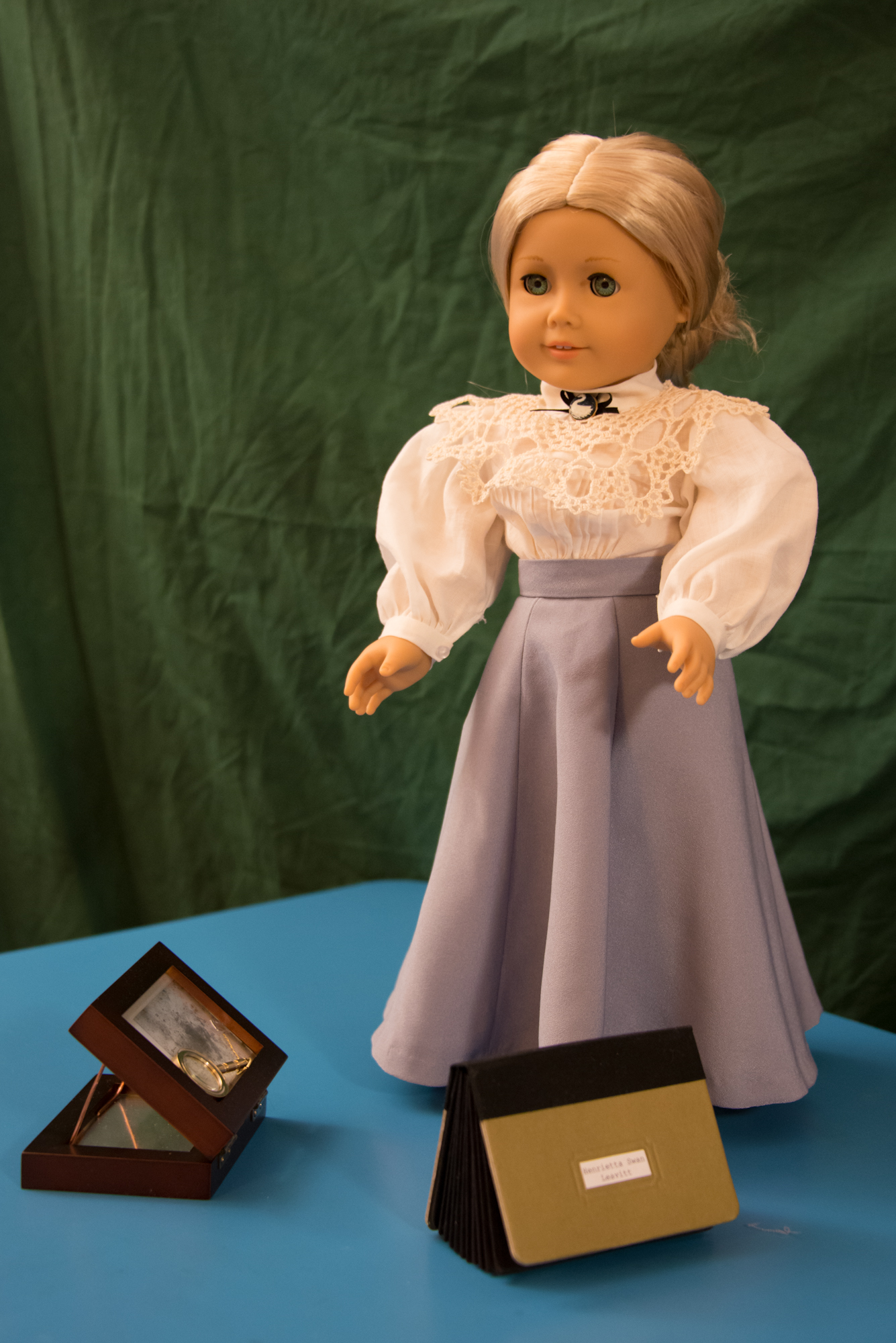
I was in transports of delight. Yes, my mother sewed those new clothes for her. (The skirt is leftover fabric from my prom dress oh so many years ago.). My father worked on the accessories:

  • Light-box
  • Magnifying glass (it works)
  • Flyspankers (see paragraph 2: http://www.starwrite.org/harvard.html)
  • Folio with “glass” plates of the Magellanic Clouds, Henrietta’s scientific paper on Cepheid Variables, and photographs

Henrietta Swan Leavitt

Henrietta Swan Leavitt made it possible for us to measure the size of the Universe.

Yup. read that again. Henrietta Swan Leavitt made it possible for us to measure the size of the Universe.

Ostensibly she was working as a “computer” (what women who did the computational or classification work in astronomy were called in those days) for Dr. Edward Pickering at the Harvard College Observatory.

It was there, rubbing elbows with other famous women of astrophsics like Annie Jump Cannon, as she was classifying the sizes of variable stars in the Magellanic Clouds that she discovered the period-luminosity relationship in Cepheid variable stars.

Variable stars are, as they sound, stars that vary in brightness. What Henrietta discovered, is that for Cepheid variables, the brightness of the star (luminosity) and the period (time between brightest moments) are related. The longer between “blinks” the brighter the star. This means that if you can see a star varying and time between the “blinks” you can figure out how bright that star actually is, not just how bright it looks. (Remember that farther away stars look dimmer, but if you got closer to them they’d look brighter).

By knowing how bright a star truly is, you can accurately measure the distance to that star by how dim it appears to be. Which means you can now measure the distances to things outside our galaxy.

Go read up some more… and let’s investigate the rest of those women computers from Pickering’s lab. Did they all make awesome discoveries? Margaret Harwood, Mollie O’Reilly, Edith Gill,  Evelyn Leland, Florence Cushman, Marion Whyte, Grace Brooks, Arville Walker, Johanna Mackie, Alta Carpenter, Mabel Gill, and Ida Woods.

Want More?

*In case you’re curious, the doll is the newest historical American Girl: Caroline, with her hair pulled back in a bun.

Henrietta Swan Leavitt from the AAS

Cepheid Variable Stars

Links!

~ A l i c e !

Ada Lovelace Day Featuring: Pamela Gay

Pamela Gay

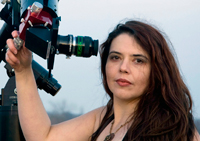
Yes, this is an actual photo of an actual astrophysicist. Why are you asking?

Good morning! Welcome to Ada Lovelace Day, a day where we celebrate women in technology (etc) through blogging.

I’d like to introduce you to a friend of mine, Dr. Pamela Gay, research astronomer, podcaster, gateway to science for the average Mr. or Ms. Doe, Skye-rider (that’s her horse), and internet-addict. Oh, and P.S. – you didn’t hear it from me but she has two X chromosomes. That’s right, she’s female.

Pamela Online

Although she does many things (in her own words, “Some days I suspect I wear too many hats. Other days, I know I wear too many hats!”) and I’ve heard tell she has a penchant for variable stars, Pamela’s research at the moment is focused online, and on how it is that internet users interact with astronomy content. She certainly has plenty of fodder for this research: her online projects include writing, voicing, and producing Astronomy Cast; masterminding 365 Days of Astronomy (you’ve heard me on there once, and you’ll hear me again in May); and being part of the Zooniverse team – a citizen science astronomy project. Oh, and of course she has a blog: StarStryder.

A la Twitter, I asked her to describe herself in 140 characters or less. I’m not sure I could do it, but she did:

I am a female scientist focused on communicating the majesty of the universe & the realities and struggles of academia one day at a time.

Teaching and Learning

No matter how much you enjoy your job, there are going to be at least a few days where you’d rather not get out of bed. A few tasks you just don’t want to face. On those days you focus on the part you love. For Pamela  it’s easy to identify: “seeing students realize they can be more then they ever imagined and can do more with their lives than they ever dreamed,” she says. I have to agree. Watching a moment of understanding, seeing students achieve something they’ve fought for – that’s the reward for teachers.

It’s also why I admire Pamela’s work. Not only does she have the Ph.D. in Astrophysics, but she pushes back against the idea that this means she has to sit holed up in an office cranking through numbers and churning out papers. She teaches in as many ways as she can, even when colleagues choose not to treat that output as valuable (a judgment both teachers and women have to face fairly often).

Thing is, it’s people like Pamela who will influence the next crop of astrophysics researchers. It is people like Pamela who will convince students that they can become the next Nobel Laureate or the next Carl Sagan or the next professor of Astronomy. And she’s not “just a teacher,” she’s published – over and over and over again. She’s documented her influence scientifically.

Only Human

Sometimes it seems like the women we look up to have superpowers. Guess what? Einstein and Annie Jump Cannon were human, and so is Pamela. She might have caffeine running through her veins rather than blood, but she makes time in her life for her husband, horseback riding (did you hear that girls near the age of seven? You can be an astrophysicist and also continue to love horses!), gardening, and renovating her house.

So, listen to her next podcast and enjoy it, whether you decide to go into astronomy research or not. If you do decide to head in that direction though, “open doors for yourself by playing with technology,” says Pamela. You’ll be able to use the experience. Take some programming classes, some math classes, and definitely learn to write – if you can communicate your ideas you’ll be able to show people why what you do is cool, and you’ll be able to convince folks to give you funding.

Want More?

Last year I blogged about Susan Sakimoto, and mentioned a lot of other people I admire and respect:

I always have trouble deciding who to write about. There’s Ada herself, of course, and Annie Jump Cannon, Cecelia Payne-Gaposhkin, and Williamina Fleming. And then there are the current scientists (most of whom you’ve never heard of because you tend not to get famous until you’re dead or almost dead): Hannah Jang-Condell, Susan Sakimoto, Andrea Dobson, Pamela (the list goes on and on and on). Not to mention my students or the faculty and grad students I’ve met at the University of Washington. Students are really important and really inspiring – except when they’re slacking off. You can see some women in science I’ve met (as interviewed by two high school interns last summer) over at the Scientists Like Me project – which will eventually become part of the We Are All Astronomers project (another Pamela special).

~ A l i c e !

http://findingada.com/

http://www.sdsc.edu/ScienceWomen/cannon.html

http://www.carleton.edu/departments/PHAS/Astro/pages/marga_michele/Cecilia_Payne.html

http://ocp.hul.harvard.edu/ww/people_fleming.html

http://womeninastronomy.blogspot.com/